Most email platforms list social posting on the feature grid. Here is how to work out whether the included feature covers the job, or whether the team will end up paying for a scheduler anyway.
Nearly every email marketing platform now lists social media somewhere on its plan comparison. Constant Contact includes social posting on all tiers, including the entry plan. Mailchimp has offered social features in various forms. The checkmark appears next to email templates and reporting, and a buyer comparing two products reasonably concludes the social requirement is handled.
Some months later the same team is paying for a separate scheduling tool. This is common enough to be worth explaining, and the explanation is not that the vendors were dishonest. Posting to a social network and managing social media are different jobs, and the checkmark refers to the first one.
Posting and managing are different jobs
Posting is a single action: take this text and this image, send it to this network, optionally at this time. It is genuinely useful, it is not difficult to build, and for some organizations it is sufficient. A solo operator who writes a post and publishes it immediately needs nothing more.
Managing is the work surrounding that action. Deciding what goes out and when across several weeks. Adapting one idea to three networks that reward different formats. Getting the post reviewed before it publishes, by someone who did not write it. Keeping the visual identity consistent when four people are producing content. Seeing what already occupies next Tuesday before adding to it. Handling the replies and messages that arrive afterward. Knowing which posts related to which campaign when reviewing results.
A bolt-on posting feature addresses the action. It rarely addresses the work around it, because that work is a different product with a different data model. This is why the feature grid can be accurate and the buying decision still wrong.
What is usually missing
Four things account for most of the gap.
A calendar that shows the whole picture. Posting features typically present one post at a time. What a planning team needs is the month laid out — what is scheduled, what is still a draft, what is awaiting review, where the gaps are, and where three posts have accidentally landed on the same morning. Without that view, planning happens in a spreadsheet and the tool becomes a publishing endpoint rather than a planning surface. The social media content calendar guide covers how far ahead that view needs to extend for a lean team.
Review before publishing. A posting feature usually publishes what it is given. There is no state between "draft" and "live" in which a second person signs off, and often no permission model that distinguishes drafting from publishing. For a regulated organization, a nonprofit answering to a board, or a business where the owner wants final say, this is disqualifying — and the workaround, sending screenshots for approval in chat, leaves no record of what was approved.
Per-platform adaptation. The same image does not work at the same dimensions on Instagram, Facebook, and LinkedIn, and the same caption rarely reads well on all three. A feature that broadcasts identical content to every connected network produces posts that look correct on one and awkward on the others. Doing it properly means either three manual variants or a tool that handles resizing and per-network copy as part of the composition step.
The replies. Publishing is half of social media. Comments and messages arrive afterward, and if they live only in each network's native app, they are checked inconsistently and answered by whoever happens to look. An email platform's posting feature almost never includes an engagement inbox, because inbound social conversation has nothing to do with email campaigns.
Why teams end up with a second tool anyway
The sequence is consistent. A team adopts an email platform primarily for email, which is the correct primary reason. Social posting is included, so nobody prices a scheduler. Then the team grows to three people and needs review before publishing. Or a manager asks to see next month's plan and there is no view that shows it. Or someone posts a vertical image to LinkedIn and it crops badly. Or a customer complaint sits unanswered on Facebook for four days.
Each of these is small. Each is solved by adding a tool, and a scheduler is inexpensive relative to the email platform. So the team now runs two subscriptions, and the coordination problem begins: the campaign brief lives in one place, the email in another, the social posts in a third, the images in a shared drive, and no single view shows what a customer received this month. That fragmentation, rather than the second subscription fee, is the actual cost — and it is the subject of what to do when marketing lives in six different tools.
The point is not that adding a scheduler is wrong. It is that the decision was made by default rather than deliberately, months after the platform choice that should have accounted for it.
How to test whether an included feature is enough
Feature grids cannot answer this. A trial can, if it is used to run a realistic piece of work rather than to click through menus.
Take one campaign the team actually runs — a monthly newsletter with supporting posts is ideal, since it is ordinary and recurring — and attempt it end to end in the trial. Write the email. Create the social posts that promote it. Schedule them across every network the organization uses. Route the whole set to whoever normally approves things, using only the tool. Publish one post, then find the replies it generates. Afterward, look for a single view showing what went out and how it performed.
Note every point where the work left the tool. A screenshot pasted into chat for approval is one. A spreadsheet holding the schedule is one. Resizing an image in another application is one. Opening a network's own app to answer a comment is one. Rebuilding the same message a second time for a different channel is one.
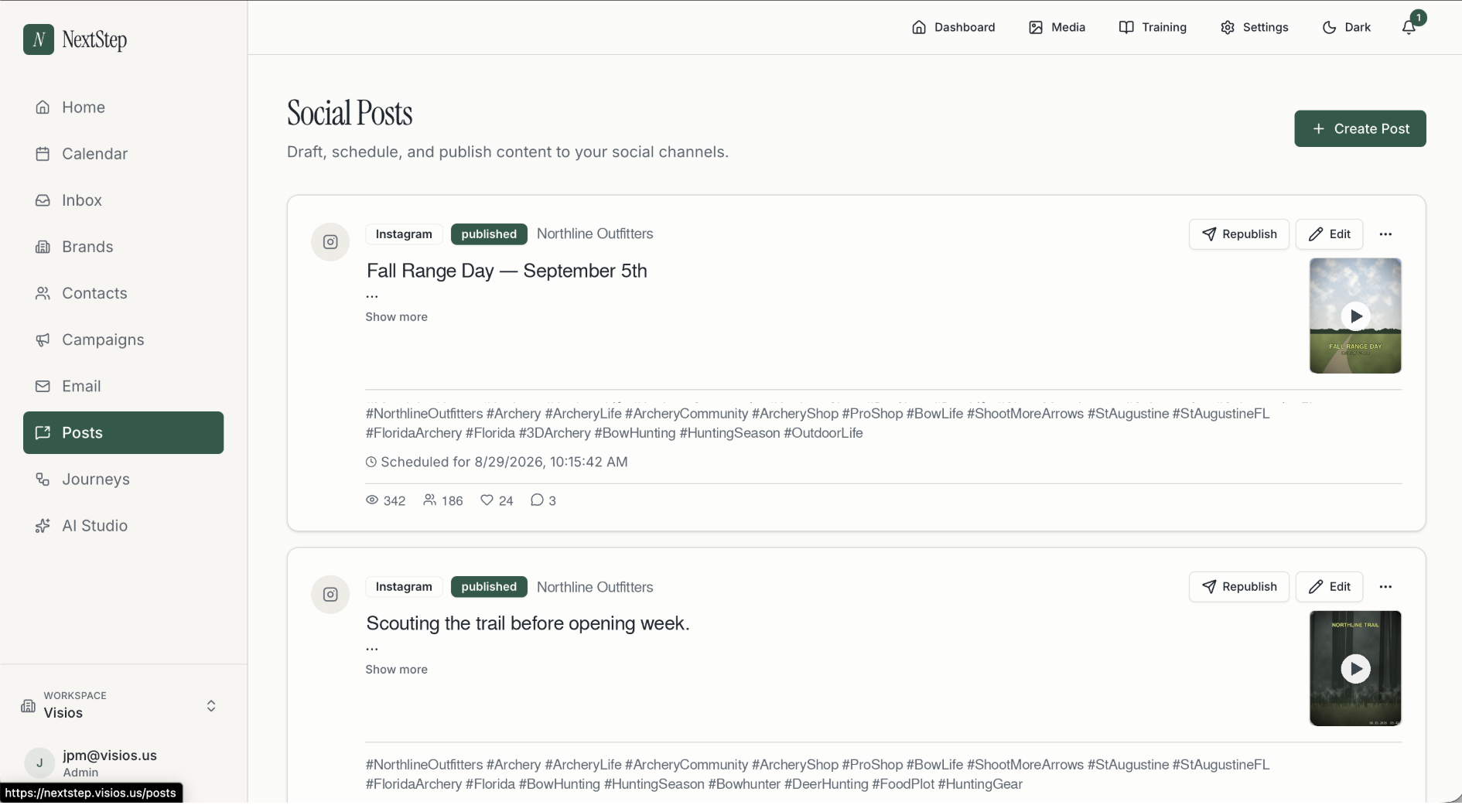
A handful of exits is normal and fine; no tool covers everything. A dozen exits means the feature is a posting endpoint and the team should budget for a scheduler now rather than discover the need in month four. NextStep approaches this differently by keeping the social scheduling calendar and email campaigns in the same workspace with shared contacts and approvals, and by handling per-platform image resizing during composition. Whether that consolidation is worth anything depends entirely on how many exits the test produces — for a team that finds two, it is not worth switching for.
When a dedicated scheduler is the right answer
There is a version of this argument that overreaches, and it is worth naming.
Organizations doing serious social media work should use serious social media software. A team running paid social alongside organic, publishing to six networks including ones that connected workspaces do not support, managing a community with high inbound volume, coordinating creators, or requiring detailed competitive and listening analytics needs a dedicated platform. A combined workspace covering the common networks well is not a substitute for that, and choosing one to save a subscription would be a downgrade.
Equally, a team whose social presence is one post a week from one person does not need a calendar, an approval chain, or an engagement inbox. A posting feature bundled into an email tool is exactly right, and the extra structure is overhead.
The combined approach fits a specific and fairly common middle: a small team, more than one person, publishing to the major networks a few times a week, needing review before things go out, and running email alongside it for the same audience. That team is poorly served by both ends — too coordinated for a posting checkbox, too small to justify running two platforms and reconciling them by hand.
Ask the question before signing up, not after
The useful reframe is to stop asking whether a platform includes social media and start asking which specific jobs it performs. Can a manager see next month? Can a post be approved before it publishes, by someone with different permissions than the author? Does one idea become three properly formatted posts without three rounds of manual work? Do replies arrive somewhere the team checks? Can the campaign be seen whole, email and social together, when someone asks how it went?
Those answers determine whether a checkmark on a feature grid describes the work being done. They take an afternoon in a trial to establish, and they are considerably cheaper to establish then than to discover in the fourth month of a subscription that has already become the place the contact database lives.